
After Russia’s full scale invasion of Ukraine, the EU, Ukraine itself and almost 20 other countries introduced wide-ranging economic sanctions against the Russian state. The sanctions also target companies and individuals closely linked to the regime and the war effort.
These sanctions are now being challenged by Russian oligarchs and companies in private tribunals using a mechanism written into investment treaties, known as investor-state dispute settlement (ISDS). While the cases are in early stages, they are already having a severe impact on EU sanction policy and Ukrainian national security policy.
A clear example is the current standoff over the use of immobilised Russian assets. The European Commission and most EU member states want to use 90 billion euros of Russian assets held at Euroclear to provide financial support to Ukraine. But the Belgian government, where Euroclear is located, has blocked the use of the funds
due to the risk of being sued.
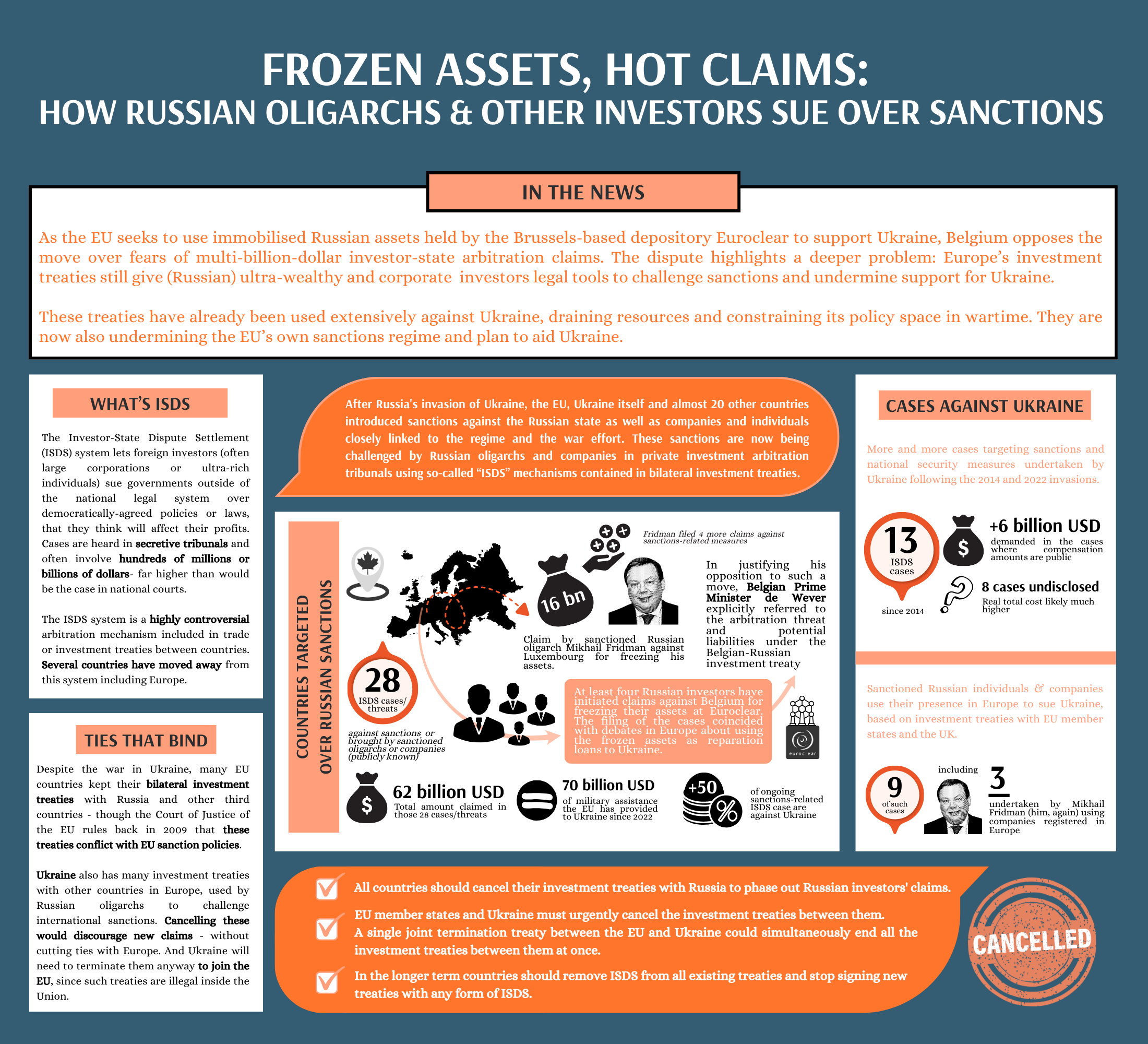
Our analysis reveals that 24 publicly known ISDS cases have been initiated directly challenging sanctions against Russia, out of a total of 28 sanctions- related cases and threats. The cases challenging sanctions include:
- The sanctioned Russian oligarch Mikhail Fridman is suing Luxembourg for 16 billion USD for freezing his assets;
- Several Russian investors are initiating claims against Belgium over the freezing of Russian-held assets at Euroclear;
- Investors are suing Ukraine in two separate cases over the removal of a Russian-linked bank from Ukraine’s banking sector, for a combined amount of 1.4 billion USD.
Our analysis also shows that:
- Overall, known ISDS claims and threats of claims by sanctioned individuals and entities already amount to 62 billion USD. This is getting close to the 70 billion USD of military assistance the EU has provided to Ukraine since 2022. The true figure is very likely to be significantly higher as in more than half the cases no information about the amounts claimed is available.
- More than half of the ongoing, sanctions-related ISDS cases are against Ukraine. The others are targeting other European countries (Belgium, France, Lithuania, Luxembourg and the UK) and Canada.
- Seven ISDS cases against Ukraine’s sanctions and security policies are based on investment treaties with EU member states and a further two on the Ukraine-UK investment treaty. This shows that the investment treaties that European countries maintain with Ukraine have enabled sanctioned individuals and entities to directly challenge Ukraine’s national security policy.
- Russian oligarch Mikhail Fridman has filed five claims against sanctions-related measures and threatened a sixth case. Three of the five cases are targeting Ukraine, of which two are based on the investment treaty that Ukraine has with Belgium and Luxembourg and the other on one with the Netherlands.
Of the 24 cases challenging sanctions, 13 have been initiated in 2025 alone, highlighting how investors are increasingly resorting to ISDS to challenge the sanctions policy of Ukraine and its supporters.
In view of the increasing weaponisation of investment treaties to weaken the European and Ukrainian sanctions policy, it is paramount that the EU and Ukraine adopt effective measures to neutralize ISDS risks.
Recommendations
In order to reduce risks for EU and Ukrainian national security and sanction policy and to prevent the outflow of money to sanctioned entities and investors, European policy makers should immediately:
- Work with the Ukrainian government on a termination treaty for all investment treaties between European countries and Ukraine, including the elimination of the sunset clauses.
- Cancel the 41 investment treaties with Russia and Belarus currently in force and that pose the most immediate danger to Europe’s sanctions regime.
- Extend the anti-ISDS provisions of the EU’s 18th sanctions package to Ukraine. These are meant to limit the ability of sanctioned investors to pursue and enforce ISDS cases, and currently apply to EU countries and Switzerland. Extending to Ukraine should reduce the risk of further use of European investment treaties to challenge Ukraine’s sanctions and national security policy.
- Ensure that arbitral institutions hosted by or headquartered in EU Member States fully comply with EU law and the EU sanctions packages.
- Leverage the EU’s diplomatic influence to persuade third countries, such as Singapore, to adopt similar regulations denying legal effects to awards in favour of sanctioned investors (as Switzerland recently did).
- Intervene in the ongoing cases against Ukraine and Member States with amicus curiae submissions.
- Provide full transparency about the ongoing cases challenging sanctions and the sums involved, to enable policy makers and civil society to fully assess the threat the cases are posing.
Ukrainian policy makers should consider the following steps:
- Work with their European counterparts on a termination treaty for the investment treaties between the European countries and Ukraine. This should follow the model the EU countries used to cancel investment treaties between each other. The cancellation would also be necessary if Ukraine accedes to the EU, since EU countries are not allowed to maintain investment treaties with each other.
- Withdraw Ukraine from the Energy Charter Treaty and add Ukraine in the EU’s interpretative declaration and inter-se agreement including the neutralisation of the sunset clause.
- Provide full transparency about the ongoing cases against Ukraine and the sums involved to enable policy makers and civil society to fully assess the threat the cases are posing.
The findings above shed a new light on the risks posed by the controversial ISDS system, revealing that it endangers sovereignty over policy making even on national security matters. To safeguard their policy space, policy makers should therefore:
- Undertake an assessment of how other policy priorities related to national security, taxation, climate and environmental protection and other public interest areas are threatened by ISDS provisions in BITs.
- Remove ISDS from all existing treaties and stop signing new treaties with any form of ISDS.