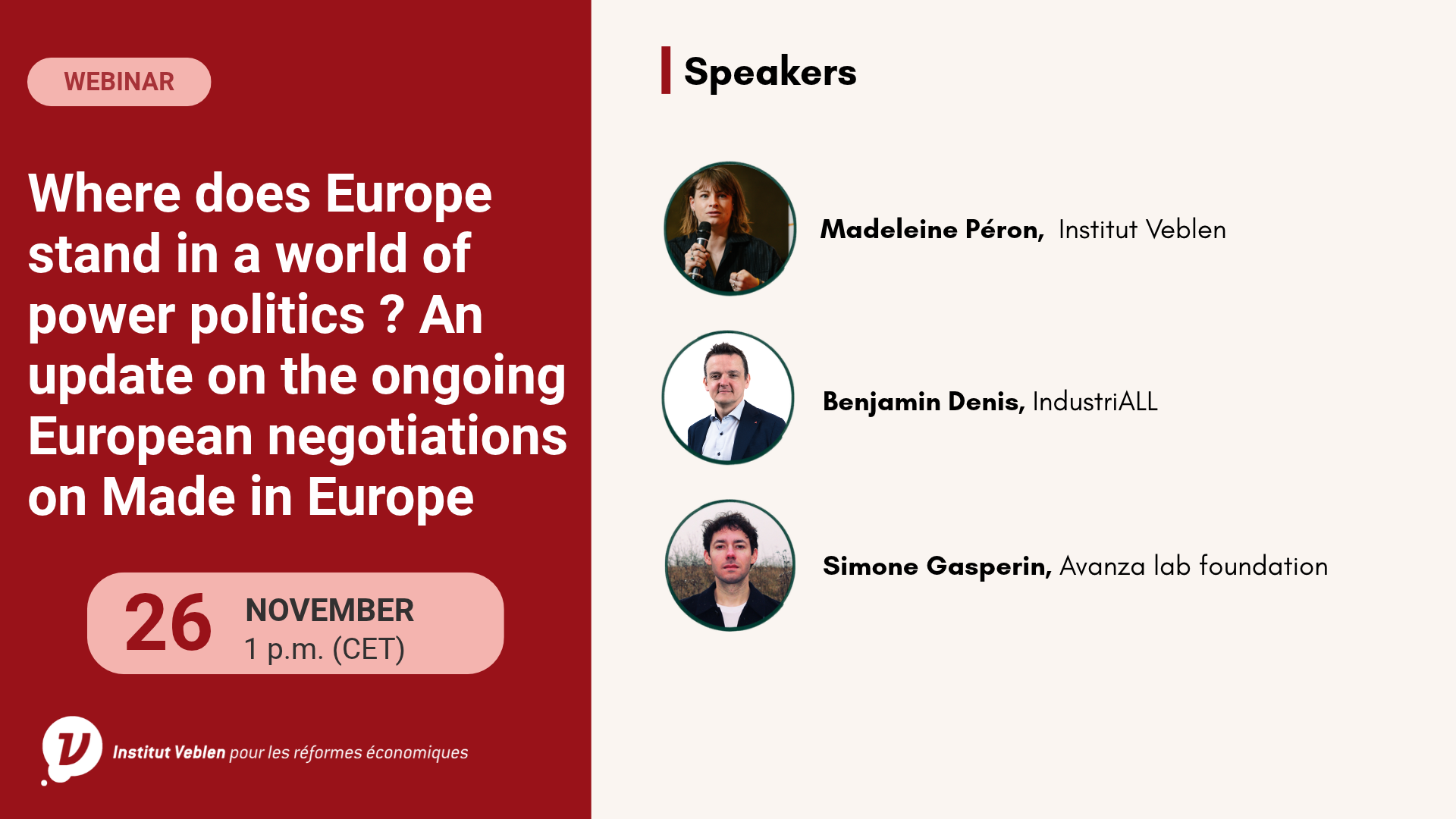
November 26, 1pm - 2:30pm (CET).
The webinar will be held in English.
Sign up by clicking here.
To tip the balance of power in its favor, the Commission has set a course: to reduce dependencies and preserve a European industrial base in key sectors of the low-carbon transition. Is this strategy up to the task?
The answer lies in part in the negotiations on the Industrial Accelerator Act, which are entering their final stretch. Proposed by the European Commission in March, this legislation aims to steer demand toward strategic European industrial production. Its adoption will be followed by that of a second piece of legislation, focused on public procurement, proposed in September.
Together, these two pieces of legislation reflect an unprecedented commitment by the Commission to use demand—and public procurement in particular—as a lever to support European industry in certain strategic sectors (steel, aluminum, cement, automotive, etc.). By introducing, in a targeted manner, the principles of European preference, they form the cornerstone of the European industrial strategy.
On the occasion of the publication of L’Économie mondiale 2027 (Editions de la découverte, Institut Français d’économie), whose chapter “Can Europe hold its own in a world of power politics ?” was written with the contribution of the Institut Veblen, the Institut Veblen is organising a webinar to decode the ongoing European negotiations on Made in Europe (Industrial Accelerator Act, Public Procurement Act).
What are the main issues at stake in the negotiations? Under what conditions will the proposed measures decisively strengthen European industries? Does the text strike a satisfactory balance between its environmental and social objectives on the one hand and its protectionist ones on the other? What links exist with the other texts under discussion in Parliament, notably the ETS and the CBAM?
To answer these questions, we will be welcoming:
- Benjamin Denis, Senior Policy advisor, industriAll Europe (Belgium)
- Simone Gasperin, Fellow, Avanza lab foundation (Spain)
- Kamil Laskowski, Project leader, Instrat (Poland)
- Madeleine Péron, Head of Program, Veblen Institute for Economic Reforms (France)